In a landmark achievement for space exploration, China's Chang'e-4 mission has successfully conducted the first-ever detailed analysis of lunar soil composition on the far side of the Moon. The findings, recently published by the Chinese Academy of Sciences, reveal fascinating geological differences between the Moon's familiar face and its mysterious hidden hemisphere, offering unprecedented insights into our celestial neighbor's formation and evolution.
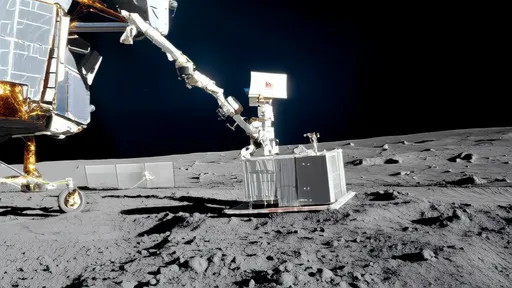
The Chang'e-4 lander touched down in the Von Kármán crater within the South Pole-Aitken basin on January 3, 2019, marking humanity's first soft landing on the lunar far side. What makes this mission particularly remarkable isn't just its location but the sophisticated suite of instruments it carried, including the Lunar Penetrating Radar and the Visible and Near-Infrared Imaging Spectrometer (VNIS), which have been systematically analyzing the composition of the lunar regolith.
Initial spectroscopic analysis of the surface material has detected the presence of olivine and pyroxene, minerals that are common in basaltic rocks. This finding suggests that the South Pole-Aitken basin, one of the largest impact craters in the solar system, may have excavated material from the Moon's upper mantle, providing scientists with a rare window into the lunar interior that isn't available on the near side.
Researchers were particularly surprised to discover that the chemical composition of the far side soil differs significantly from samples collected during the Apollo missions. The regolith appears richer in iron-bearing minerals and shows distinct spectral characteristics that indicate a more primitive, less processed geological history compared to the well-studied near side.
The implications of these compositional differences are profound for our understanding of lunar evolution. The Moon's asymmetrical development has long puzzled planetary scientists, with the near side featuring extensive volcanic plains (maria) while the far side is predominantly rugged highlands. The new data suggests that the thickness of the lunar crust, which is substantially greater on the far side, may have prevented magma from reaching the surface and creating the volcanic features so prevalent on the near side.
Another intriguing aspect of the findings concerns the presence of minerals that could potentially serve as resources for future lunar exploration. The detection of ilmenite, a titanium-iron oxide mineral, is particularly noteworthy as it could potentially be processed to extract oxygen for life support or rocket propellant. While these deposits appear less abundant than in some near side regions, their presence on the far side opens new possibilities for sustainable exploration.
The analysis also revealed unexpected variations in soil maturity across small spatial scales. Unlike the relatively uniform regolith found at Apollo landing sites, the far side soil shows dramatic changes in composition over distances of just a few meters, suggesting a more complex geological history with multiple impact events mixing materials from different depths and sources.
Perhaps the most technically challenging aspect of the mission has been maintaining communication with the lander and Yutu-2 rover through the Queqiao relay satellite. This technological achievement has not only enabled the compositional analysis but has paved the way for future far side missions that might include sample return efforts to bring these unique materials back to Earth for more detailed study.
As the Yutu-2 rover continues its unprecedented journey across the lunar far side—already having operated far beyond its designed lifespan—each new measurement adds another piece to the puzzle of the Moon's dual nature. The mission has already examined soil compositions at multiple locations along its traverse, building a progressively more detailed map of the far side's mineralogical diversity.
The success of Chang'e-4's compositional analysis represents more than just a scientific achievement—it demonstrates humanity's growing capability to explore and understand even the most inaccessible parts of our solar system. As mission controllers extend the operational timeline month after month, the world awaits further revelations about the Moon's hidden hemisphere and what it might tell us about the early history of both our natural satellite and the Earth-Moon system.
By /Aug 25, 2025

By /Aug 25, 2025

By /Aug 25, 2025
By /Aug 25, 2025
By /Aug 25, 2025

By /Aug 25, 2025

By /Aug 25, 2025

By /Aug 25, 2025

By /Aug 25, 2025

By /Aug 25, 2025
By /Aug 25, 2025

By /Aug 25, 2025

By /Aug 25, 2025
By /Aug 25, 2025

By /Aug 25, 2025
By /Aug 25, 2025
By /Aug 25, 2025
By /Aug 25, 2025
By /Aug 25, 2025
By /Aug 25, 2025
