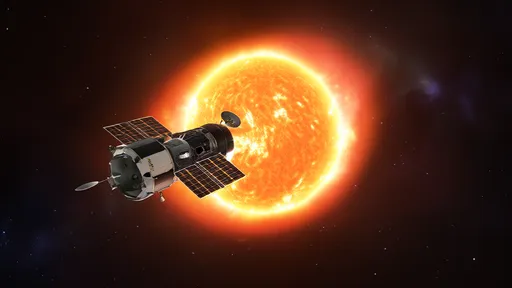
In a landmark achievement for space exploration, Japan's Hayabusa2 mission has successfully returned pristine samples from the asteroid Ryugu, offering an unprecedented glimpse into the early solar system. The meticulous analysis of these extraterrestrial materials is not just a triumph of engineering but a scientific treasure trove that promises to reshape our understanding of planetary formation and the origins of life.
The journey of Hayabusa2 began with its launch in December 2014, culminating in a precise touchdown on the carbon-rich asteroid Ryugu in 2019. After collecting surface and subsurface material, the spacecraft embarked on its return trip, delivering a sealed capsule to Earth in December 2020. The samples, carefully curated to avoid contamination, have since been distributed to international research teams for in-depth study.
Initial examinations revealed that the Ryugu samples are remarkably dark and porous, resembling chunks of charcoal rather than typical meteorites found on Earth. This physical characteristic alone underscores their pristine nature, having been unaltered by atmospheric entry or terrestrial weathering. The material is composed primarily of hydrous minerals and organic compounds, pointing to a history rich with water interactions and complex chemistry.
One of the most striking findings is the high abundance of amino acids—the building blocks of proteins—within the samples. These organic molecules were detected in both surface and subsurface materials, suggesting that Ryugu preserved them from the early solar system. The diversity and complexity of these amino acids hint at processes that could have contributed to the emergence of life on Earth, supporting the theory that asteroids seeded our planet with essential prebiotic compounds.
Further analysis using advanced spectroscopic and microscopic techniques has unveiled detailed insights into the mineralogy of Ryugu. The samples are dominated by phyllosilicates, such as clay minerals, which form in the presence of water. This indicates that Ryugu's parent body experienced extensive aqueous alteration, likely during the early stages of the solar system. The presence of carbonates and sulfides also suggests a dynamic environment where liquid water facilitated chemical reactions over millions of years.
Isotopic studies have provided clues about the age and origin of Ryugu. Measurements of oxygen and hydrogen isotopes align closely with those of certain carbonaceous chondrite meteorites, particularly the CI group, which are considered the most primitive and chemically similar to the solar nebula. However, Ryugu's samples show even fewer signs of alteration, making them a purer reference for the initial conditions of our planetary system. Radiometric dating indicates that the material is over 4.5 billion years old, contemporaneous with the formation of the Sun and planets.
The subsurface samples, collected after Hayabusa2's innovative impactor created an artificial crater, are particularly valuable. They are shielded from space weathering, such as solar wind and cosmic rays, and thus represent the asteroid's interior in a near-pristine state. Comparisons between surface and subsurface layers reveal differences in composition and structure, shedding light on how space exposure alters asteroid surfaces over time.
Another fascinating aspect is the detection of microstructural features, such as tiny voids and inclusions, which trapped gases from the early solar system. These "time capsules" contain noble gases and nitrogen, whose isotopic ratios provide a record of the environment in which Ryugu formed. This data helps scientists reconstruct the temperature, pressure, and radiation conditions prevalent in the protoplanetary disk.
The implications of these findings extend beyond academic curiosity. Understanding the composition and behavior of asteroids like Ryugu is crucial for planetary defense, as it informs strategies to mitigate potential impact threats. Moreover, the success of Hayabusa2 demonstrates the feasibility of sample return missions, paving the way for future endeavors to other celestial bodies, including comets and Mars moons.
Internationally, the Hayabusa2 mission has fostered collaboration, with samples shared among NASA, ESA, and other institutions. This global effort amplifies the scientific return, allowing cross-validation of results and multidisciplinary approaches. The data generated will undoubtedly influence upcoming missions, such as NASA's OSIRIS-REx, which aims to return samples from asteroid Bennu.
In summary, the analysis of Hayabusa2's samples from Ryugu has opened a new chapter in planetary science. By delivering untouched material from the dawn of the solar system, this mission has provided direct evidence of the processes that shaped our cosmic neighborhood. The discoveries—ranging from organic molecules to ancient minerals—not only deepen our knowledge of asteroids but also bring us closer to answering fundamental questions about our origins and the potential for life elsewhere in the universe.

By /Aug 25, 2025

By /Aug 25, 2025

By /Aug 25, 2025

By /Aug 25, 2025

By /Aug 25, 2025

By /Aug 25, 2025

By /Aug 25, 2025

By /Aug 25, 2025
By /Aug 25, 2025

By /Aug 25, 2025
By /Aug 25, 2025

By /Aug 25, 2025

By /Aug 25, 2025
By /Aug 25, 2025

By /Aug 25, 2025
By /Aug 25, 2025
By /Aug 25, 2025

By /Aug 25, 2025
By /Aug 25, 2025
By /Aug 25, 2025
